
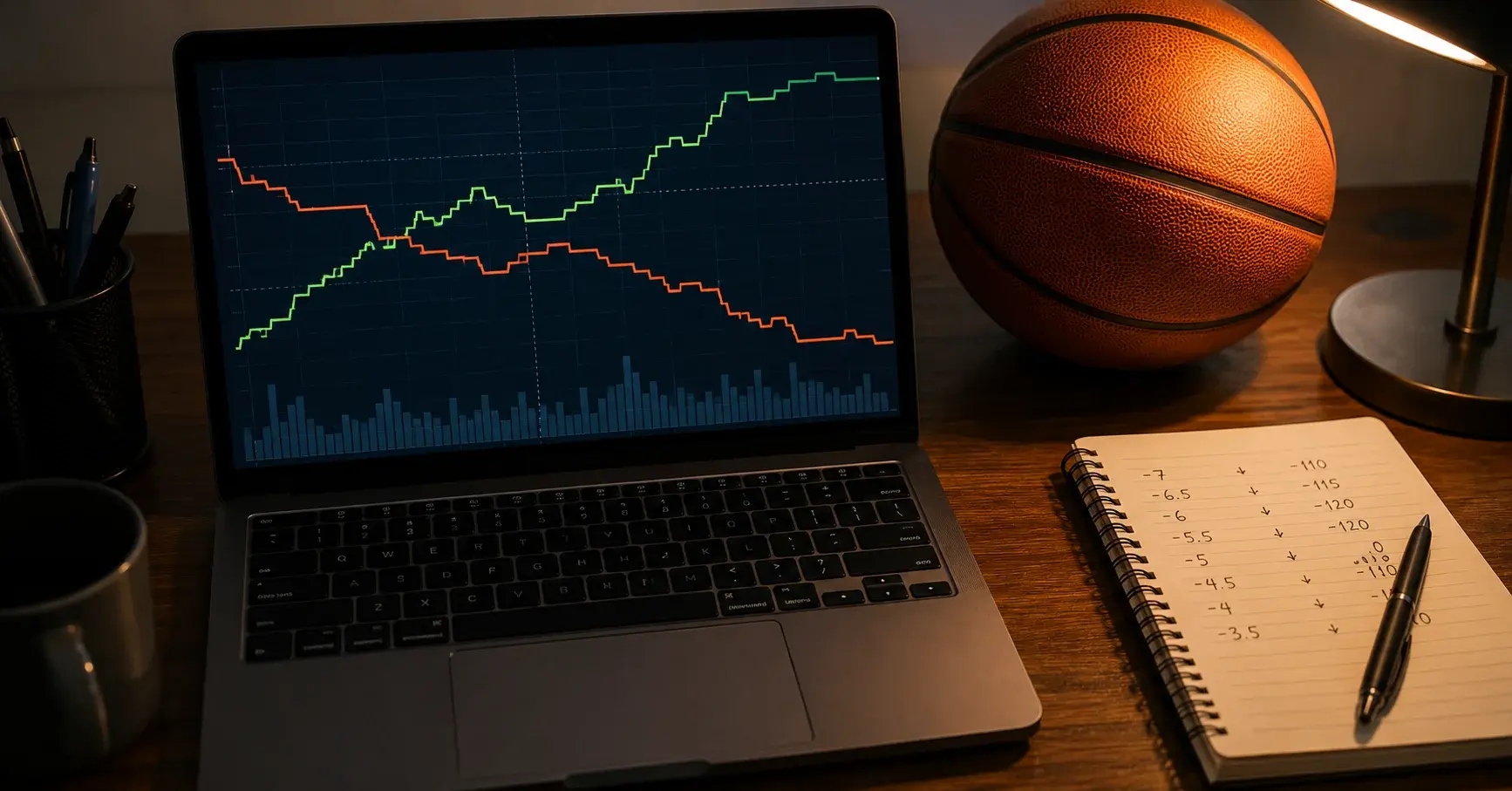
The first time I noticed a line move against the public, I assumed it was a mistake. A popular NBA team had opened as a 3-point favourite, 70% of tickets were on them, and the line dropped to -2. Every instinct said the line should be climbing, not falling. Then I realised: someone with serious money — far more than the sum of those casual tickets — had backed the other side. That was my introduction to the concept of sharp money, and it permanently changed how I read the market.
Americans legally wagered $166.94 billion on sports in 2025, and a substantial portion of that handle flowed through NBA markets. When that volume of money moves, lines respond. The trick is distinguishing between line moves driven by informed money — sharp bettors, syndicates, quantitative models — and those driven by recreational volume. Understanding this distinction is, in my view, the single most valuable skill a serious NBA punter can develop.
These steam moves become even more pronounced during the postseason, making NBA playoff series analysis crucial for identifying smart money.
Identifying Sharp Money vs Public Betting Action
Every line movement has a cause, and the two primary causes are ticket count and handle size. Ticket count reflects the number of individual bets placed on each side. Handle reflects the total money wagered. When these two metrics diverge — when 75% of tickets land on one side but 55% of the money lands on the other — you are looking at a sharp-versus-public split.
Public bettors, sometimes called squares, tend to bet popular teams, favourites and overs. They place smaller, more frequent wagers. Sharp bettors place larger, less frequent wagers and are not influenced by team popularity or recent narrative. When the sharp side of the market places enough concentrated money to move the line against the ticket majority, that is a signal worth paying attention to.
In practical terms, I track the opening line and the direction of movement relative to the public ticket split. If the public is heavily on Team A and the line moves toward Team A (making them a bigger favourite), the movement is public-driven and tells me nothing new. If the public is heavily on Team A and the line moves toward Team B (shrinking Team A’s advantage), sharp money is likely pushing the line. That reverse movement is the most reliable signal that professional bettors see value on the less popular side.
Timing adds another layer. Sharp money typically comes in early — within the first few hours after the line opens — or very late, within ninety minutes of tip-off. The early sharp action establishes the direction. The late sharp action, sometimes called “closing line value” hunters, aims to capture the last available edge before the market settles. Public money, by contrast, flows steadily throughout the day and spikes in the hours before tip-off, driven by casual engagement and media coverage.
Reverse Line Movement and What It Signals
I once watched a game where 80% of tickets were on the over, and the total dropped from 224.5 to 222.5. That two-point drop against overwhelming public support was a textbook reverse line movement. The under hit by six points. That is not proof that reverse line movement always works — nothing in betting always works — but it illustrates the principle: when the line moves against the crowd, the crowd is usually wrong.
Reverse line movement occurs when the bookmaker receives enough sharp money on one side to outweigh the cumulative public money on the other. The bookmaker is not taking a position — they are adjusting the price to balance their liability. When a small number of large bets moves the line more than a large number of small bets, the bookmaker’s algorithm trusts the informed money over the volume.
Paul Tonko, a US congressman who has pushed for federal gambling regulation, argued that “voluntary self-policing by the leagues and state regulators should be deemed ineffective.” That critique extends to market integrity in a broader sense. In a fragmented regulatory landscape, the quality of line-movement data varies by jurisdiction. For UK punters, this means relying on data from UKGC-licensed platforms and established US data providers rather than unverified social media accounts claiming to know where “the money is going.”
Not every reverse line movement signals sharp value. Injury news can move a line against public support without any sharp involvement — a star player being ruled out will shift the line regardless of where the money is. I always cross-reference reverse moves with injury reports and news feeds before interpreting them as sharp signals. A move caused by a last-minute injury designation is not sharp action; it is public information that has not yet been fully absorbed by the ticket count.
Tools and Sources for Monitoring NBA Line Movement
My daily pre-match routine takes about twenty minutes and centres on three line-movement data points: opening line, current line, and ticket-versus-handle split. You do not need paid software to track these, though paid services offer convenience and historical archives that free tools lack.
Never finalize your betting card without checking the daily market breakdowns at CourtEdge.
Several free resources provide real-time line movement for NBA games. Some display opening and current lines side by side, allowing you to see the direction and magnitude of movement at a glance. Others add ticket and handle percentages, which is the data you need to identify sharp-versus-public splits. Around 80% of bettors now use mobile for placing bets, and most line-tracking tools have mobile-optimised interfaces that let you monitor movements on the same device you use to place wagers.
One practical tip: bookmark or save the line-movement page for your preferred tracking tool and check it at three specific times each game day. First, within an hour of lines opening, to see the initial sharp direction. Second, around midday UK time, to assess whether the line has stabilised or is still moving. Third, within two hours of tip-off, to catch any late sharp action. This three-check system captures the most actionable movements without requiring you to watch lines all day.
A word of caution about social media. Twitter, Reddit and Telegram channels are full of accounts claiming to track sharp money. Some are legitimate analysts; many are not. The difference is verifiability. A credible source cites the data platform they are pulling from and shows historical accuracy. An uncredible source posts “sharp money on Team X” without methodology. I treat unverified sharp-money claims with the same scepticism I apply to unverified tipster records. The is the best retrospective check: if someone consistently identifies the sharp side before the line moves, their CLV record will confirm it.