
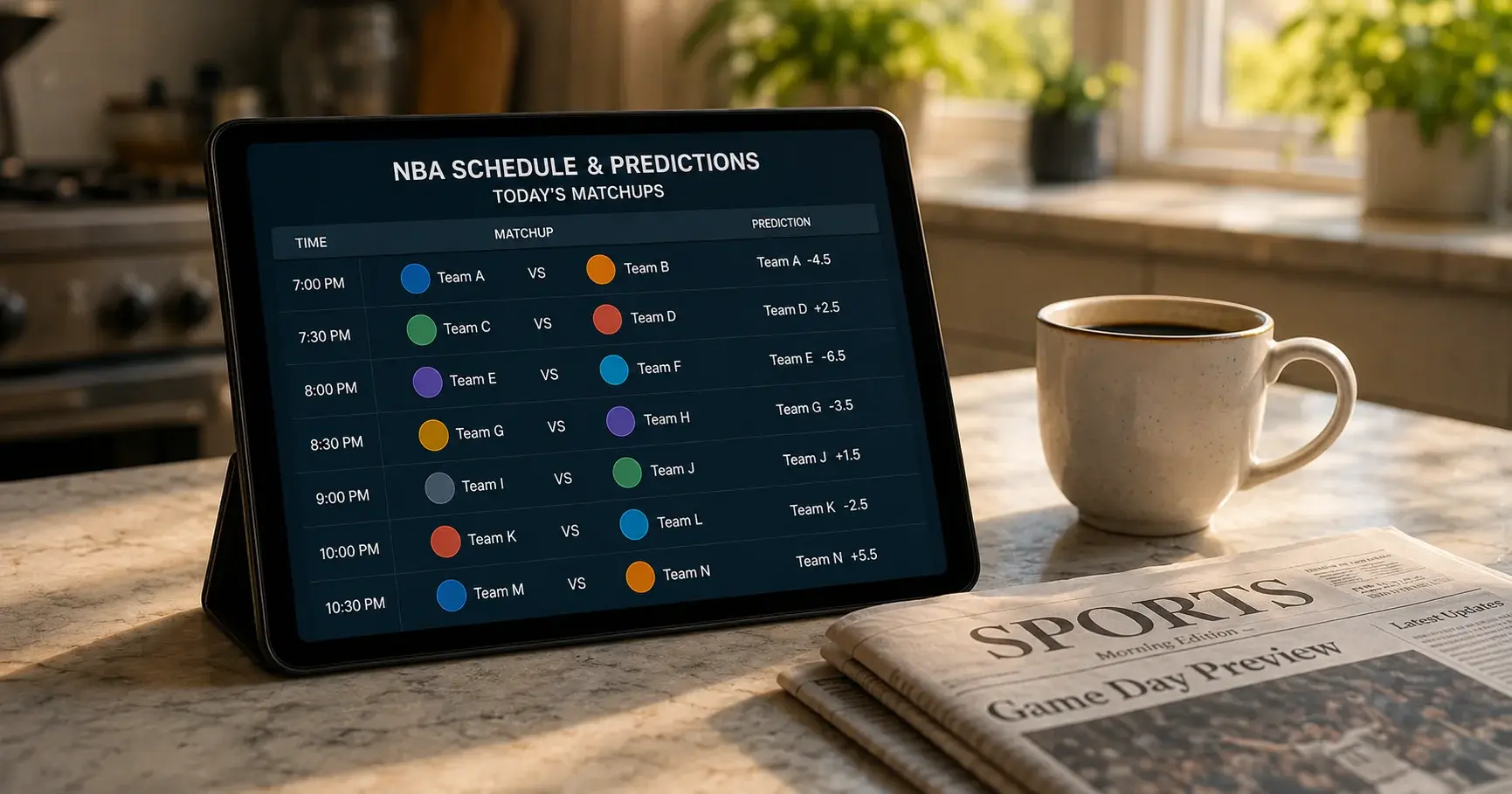
Every morning during the NBA season, I open the same four browser tabs in the same order: the NBA injury report, the previous night’s box scores, the day’s schedule with opening lines, and my own tracking spreadsheet. The entire routine takes twelve minutes. It is not glamorous, it is not exciting, and it will never make a good social media post — but it is the single most profitable habit I have developed in nine years of betting on professional basketball. A framework beats flair every time.
The temptation to skip the process and jump straight to “picks” is powerful. In the UK, 15% of men and 4% of women bet on sport, and the vast majority of that group approaches each game day without any structured evaluation method. They check a tipster’s recommendations, glance at the odds, and place a bet based on name recognition or gut feeling. A repeatable daily framework does not guarantee winning bets, but it guarantees that every bet you place is grounded in data rather than impulse — and over the long arc of an NBA season, that distinction separates the bettors who survive from those who cycle through deposit after deposit.
Establishing a Daily NBA Prediction Checklist
I built my first daily checklist on a napkin in a pub five seasons ago, and it has evolved since then, but the core structure remains the same. The checklist has six items, and I complete them in order for every game I am considering betting on. If I cannot complete the checklist before tip-off, I do not bet. That rule alone has prevented more bad bets than any analytical insight I have ever had.
Step one is the injury report. I check which players are listed as out, doubtful or questionable, and I assess the on the team’s offensive and defensive rating. A backup centre replacing a starter is a different proposition than a backup point guard replacing the team’s primary ball-handler. I do not just note who is out — I model what their absence means for the specific matchup.
Step two is the schedule context. Is either team on the second night of a back-to-back? Has either team played four games in the past six days? Did either team travel across more than one time zone to reach tonight’s venue? These factors do not appear in the box score, but they affect performance in measurable ways. I assign a fatigue modifier to each team — typically between 0 and -2 points — based on the schedule situation.
Step three is the recent form check. I look at each team’s net rating over the past ten games, not the past ten results. A team that went 6-4 but posted a +7.2 net rating is playing better than its record suggests. A team that went 8-2 but posted a +2.1 net rating is riding close-game variance and may be due for regression. The ten-game window captures recent tactical changes and rotation adjustments that the season-long numbers might dilute.
Step four is the line comparison. I check the opening line, the current line at three different bookmakers, and the direction of movement. If the line has moved toward the side I am leaning, the market agrees with my analysis and the remaining value may be thin. If the line has moved against my lean, I either have an edge the market has not found or I am wrong. Both are useful pieces of information.
Step five is the value threshold check. I compare my projected margin to the bookmaker’s implied margin. If the difference exceeds 1.5 points, I have a potential bet. Below that threshold, I pass. This rule eliminates roughly 60% of the games I evaluate, which is exactly the point — most games are priced efficiently, and the discipline to pass on “interesting” games that do not meet the threshold is what protects my bankroll.
Step six is recording the bet in my tracking spreadsheet before I place it. I log the date, teams, my projected edge, the line I am betting, and my unit size. This forces me to commit to the analysis in writing before money changes hands, which eliminates the last-second impulse adjustments that used to cost me dearly.
Evaluating Head-to-Head Matchups for Today’s Games
The checklist gets me to the point of identifying which games might offer value. The matchup evaluation digs into why. NBA games are won and lost on specific matchup advantages — a dominant interior scorer against a team that ranks last in rim protection, a three-point-heavy offence against a team that leaves shooters open on the perimeter — and these advantages are not always reflected in the spread.
With upset rates in the NBA running between 35% and 40%, head-to-head matchup dynamics explain a significant portion of the games where the underdog wins outright. The most reliable matchup indicator I use is the pace differential. When a team that ranks in the top five in pace faces a team that ranks in the bottom five, the game tends to land closer to the faster team’s preferred tempo — which means the total is likely to exceed the posted number, and the faster team’s spread performance tends to improve because it is playing in its comfort zone.
Defensive matchup analysis is where I spend the most time. I look at each team’s defensive rating against specific play types: pick-and-roll ball-handler, isolation, spot-up shooting, and transition. If tonight’s matchup pits a team that generates 25% of its offence from isolation against a team that ranks in the bottom ten at defending isolation plays, the offensive team has a schematic advantage that the generic spread may not fully price in. This kind of play-type analysis is available for free on NBA.com and takes ten minutes per game to review.
Why a Framework Beats Chasing Free Picks
I understand the appeal of free picks. Someone with a confident voice and a verified track record tells you who to bet on, and all you have to do is follow. It requires no time, no analysis, and no emotional investment in the process. The problem is that free picks — even from legitimate tipsters — cannot account for your individual circumstances: your bankroll size, your risk tolerance, the specific odds available at your bookmaker at the moment you place the bet, and whether the line has moved since the pick was published.
A framework is portable and personal. It adapts to your schedule, your bankroll, and your strengths. If you are better at analysing defensive matchups than offensive ones, your framework can weight that factor more heavily. If you prefer to bet totals rather than spreads, your checklist can prioritise pace and efficiency data over margin projections. The framework belongs to you, and over time, it becomes a reflection of your specific analytical edge — something no free pick service can replicate.
The other advantage of a framework is accountability. When you follow a tipster and lose, you blame the tipster. When you follow your own framework and lose, you have a specific process to review: Did I miss an injury? Did my fatigue modifier underestimate the schedule impact? Was my net rating data stale? Each loss becomes a data point that improves the framework for the next game. Over the course of a full NBA season — 1,230 regular-season games, followed by months of playoffs — the compounding effect of incremental improvements to your framework produces results that no static pick list can match.