
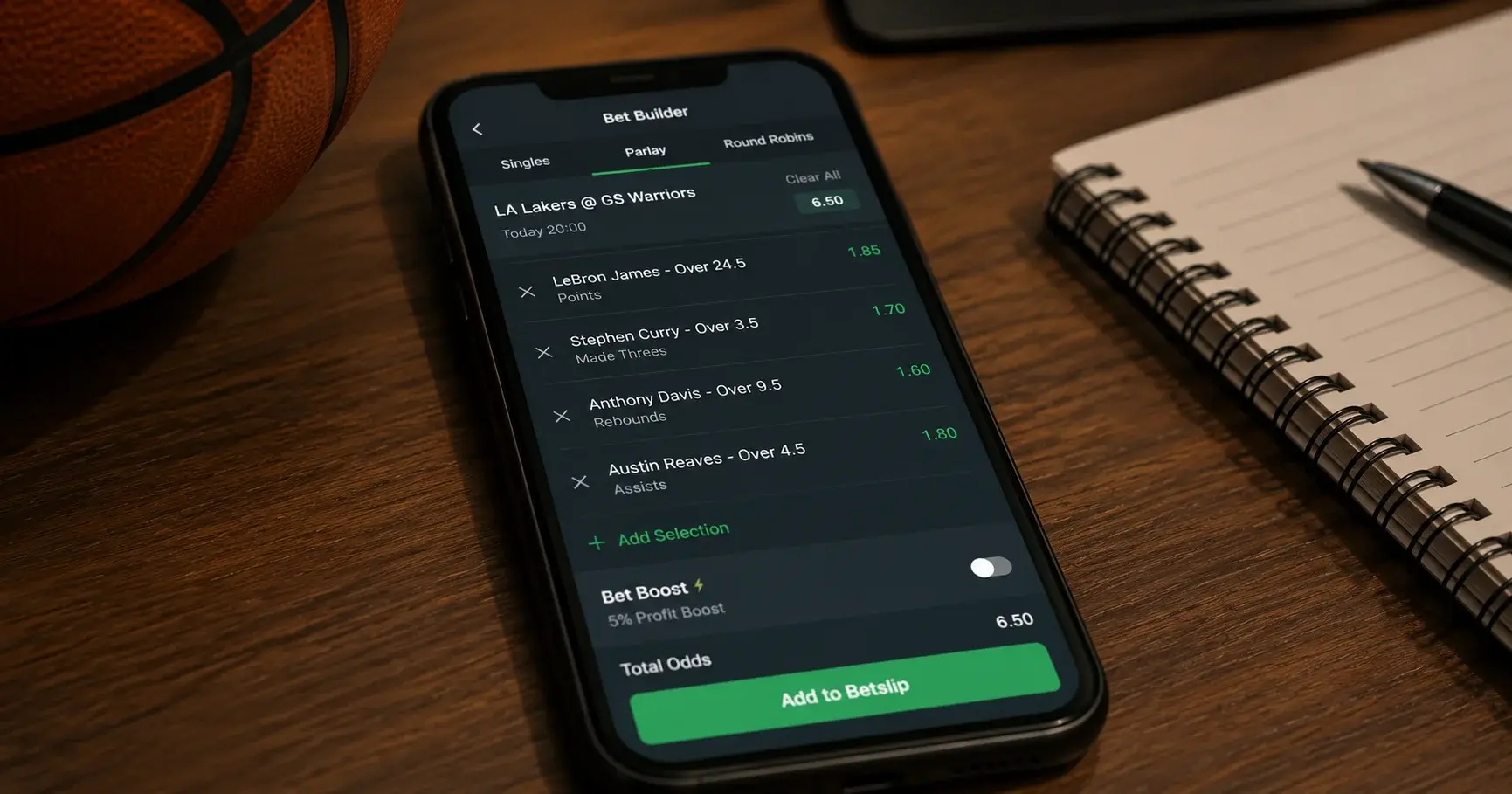
The first same game parlay I ever placed looked brilliant on paper: a team to win, its star guard to score over 25.5 points and the game total to go over 220.5. Three legs, a juicy combined price, and the satisfying feeling of having “built” something. The team won by 20, the guard finished with 31 points, and the total landed at 218. Two legs hit, one missed, and the entire bet was dust. That experience taught me the core truth about same game parlays — they are designed to feel clever while quietly stacking the odds against you.
Same game parlays, known as bet builders at most UK bookmakers, allow you to combine multiple selections from a single NBA game into one wager. The appeal is obvious: higher potential returns from a single match. The danger is less obvious: the bookmaker controls how correlated outcomes are priced, and that pricing almost always tilts in the house’s favour. Sportsbook hold — the margin built into every market — sits at around 10.2% on standard sides and totals. On same game parlays, the effective hold is significantly higher because the bookmaker adjusts odds on each leg to account for correlations you might not fully understand.
This article is a guide to building same game parlays that make mathematical sense, not just emotional sense. I will walk through how correlation works, which legs genuinely add value and why the bet builder interface is engineered to encourage mistakes.
Choosing Legs That Add Value, Not Variance
Every bet builder interface I have used across UK bookmakers is designed to encourage you to add legs. More legs means a bigger number on the potential payout line, which triggers the same part of your brain that responds to a lottery jackpot. Resist that impulse. The maths works against you with every additional leg.
Two or three legs is the sweet spot if you insist on playing this market. Beyond three legs, the combined probability of all outcomes hitting drops so sharply that the payout rarely compensates for the added risk. I treat same game parlays as an occasional tool, not a daily strategy. When I do build one, I follow a strict process.
First, I look for legs where my own analysis gives me an edge independent of the parlay. If I would not bet a player’s points over as a single, I do not include it as a leg. Second, I check the correlation direction. I want legs that are either genuinely independent or slightly negatively correlated, because those combinations are where bookmakers are least likely to have over-adjusted the price. A player rebounds over combined with the opposing team’s total points over is a pairing where the correlation is weak — the player’s rebounding depends on shot attempts and positioning, while the opponent’s scoring depends on their own efficiency. Third, I avoid legs that are obviously correlated: team to win and the team’s star to score high, or the total to go over and both teams to score above a threshold.
The feed directly into same game parlays, so understanding how individual stat lines are priced gives you a significant advantage when selecting legs. A deep analysis of a player’s usage rate, minutes projection and matchup profile can reveal whether a prop line is mispriced — and a mispriced prop is worth including as a parlay leg precisely because the bookmaker’s correlation adjustment does not fix the underlying line error.
Step-by-Step Bet Builder Walkthrough
Rather than abstract advice, here is exactly how I build a same game parlay from scratch using a UK betting app. Mobile platforms handle over 70% of basketball betting volume, so this workflow is designed for the screen you are most likely using.
Step one: select the game. I only build same game parlays on games where I have already done a full pre-match analysis — injury check, schedule context, pace comparison. I never use the bet builder as a starting point for research; it is the final step after the analysis is complete.
Step two: identify my primary thesis. Am I expecting a high-scoring game? A blowout? A close defensive battle? That thesis guides which legs make sense. If I expect a blowout, I might combine the favourite to win with a role player on the winning team to hit a points over — in a blowout, bench players get extended minutes, which inflates their counting stats.
Step three: check each leg independently. I open the individual market for each selection and compare the single price against the same selection inside the bet builder. If the bet builder significantly discounts a leg compared to the single market, that is a red flag — the correlation adjustment is eating too much value.
Step four: limit to two or three legs. I calculate the combined implied probability by converting each leg’s decimal odds to implied probability and multiplying them. Then I compare that figure to the bet builder’s offered price. If the bet builder’s price implies a probability more than 5% higher than my calculation, the value is not there and I skip the bet.
Step five: stake conservatively. Same game parlays are inherently higher variance than singles. I never stake more than half a unit on a bet builder, regardless of how confident I feel. The variance will catch up with you over any meaningful sample size, and protecting your bankroll on these plays is non-negotiable.