
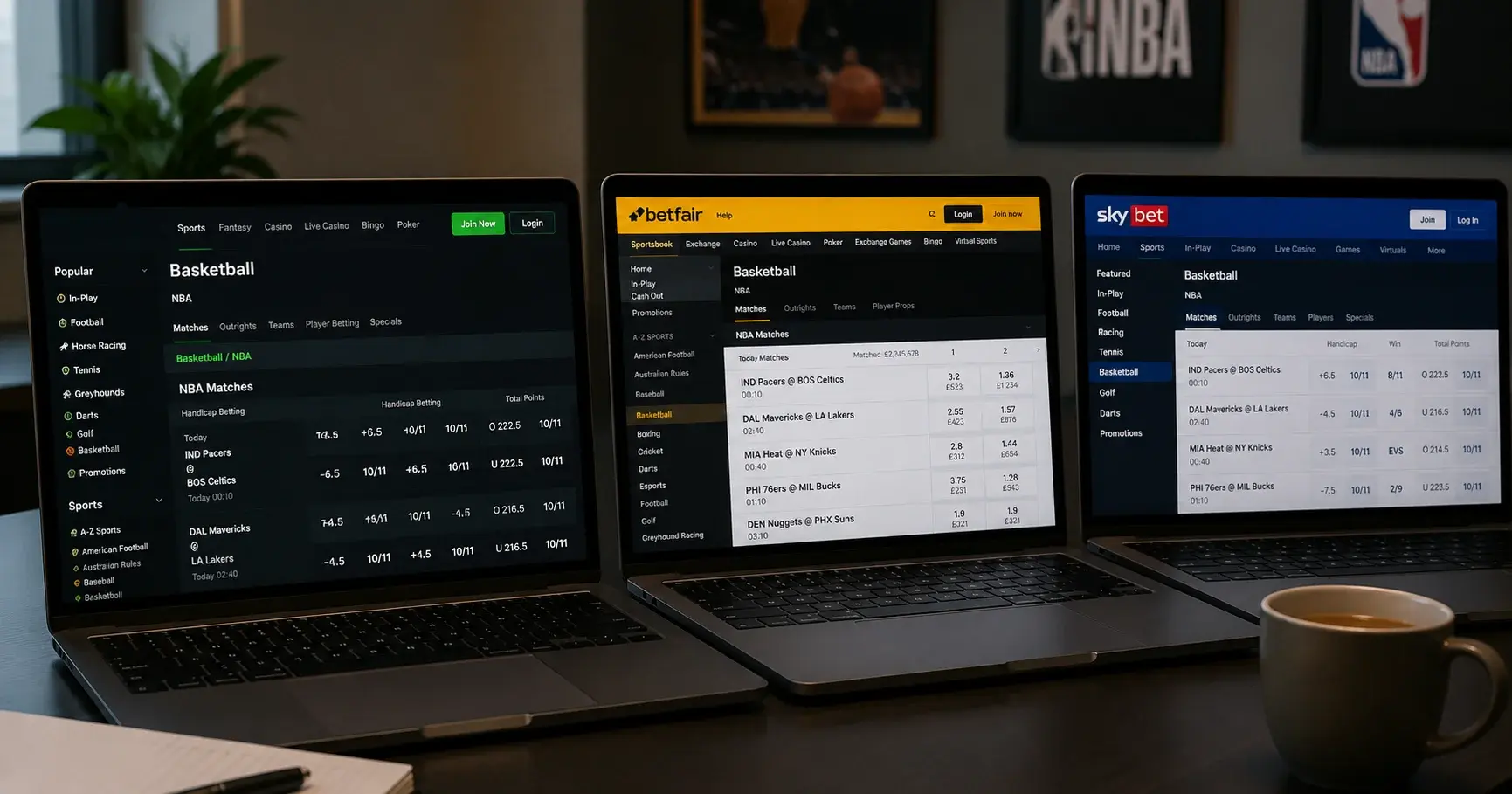
Flutter Entertainment — the parent company behind Sky Bet, Paddy Power and Betfair — reported group revenue of $15.91 billion in 2025, a 17% year-on-year increase. That number tells you something important about the UK betting landscape: the major operators are enormous, well-resourced and competing aggressively for your custom. But size does not automatically translate to depth when it comes to NBA coverage. I have held accounts at six different UKGC-licensed bookmakers simultaneously for years, and the variation in their NBA market offerings is genuinely surprising. One operator might list 150 markets on a Lakers-Celtics game while another covers the same fixture with fewer than 30. If you are serious about NBA betting in the UK, understanding which bookmakers offer what — and where the gaps are — is not optional. It is the foundation of getting fair prices.
This guide compares the breadth of NBA coverage across UK operators, examines how much odds actually vary between bookmakers on the same game, and identifies the most common coverage gaps that UK NBA bettors need to work around.
Assessing Market Breadth Among Leading UK Operators
The UK sports betting market generates £2.48 billion in annual Gross Gambling Yield, and the majority of that is concentrated on football, horse racing and tennis. NBA sits further down the priority list for most operators, which means the resources dedicated to pricing NBA markets vary significantly from one bookmaker to the next. In practice, this creates a tiered system where a handful of operators offer deep NBA coverage and the rest provide only the basics.
The top tier — typically the largest operators with established US-facing brands or partnerships — offers a full range of NBA markets on every regular-season and playoff game. This includes moneyline, handicap (spread), totals, player props for major statistical categories (points, assists, rebounds, three-pointers made), quarter and half lines, team totals, first-basket scorer, double result and various specials. During the playoffs, these operators expand further to include series winner, exact series result, series handicap and MVP markets. The total count can exceed 200 individual betting options on a single game.
The middle tier offers the core markets — moneyline, spread and totals — on all games, with player props available on marquee matchups but not on the full slate. If you want to bet on a Tuesday night game between two mid-table teams, the middle-tier operators may give you only five or six market options. This is fine for casual bettors but limiting for anyone who wants to bet player props or quarter lines consistently.
The bottom tier covers NBA sporadically. Some smaller operators list NBA games only on weekends or only during the playoffs, and the market depth even on listed games is minimal. I do not recommend relying on these operators for NBA betting — the odds are typically wider than at the larger operators, and the market selection is too narrow to support a disciplined betting approach.
The practical takeaway is that UK NBA bettors should hold accounts at a minimum of three top-tier operators. This gives you the market depth to find the bets you want and the price comparison to ensure you are getting fair value on each one. For more detail on , start with the licensing, odds quality and market depth criteria that separate strong operators from weak ones.
How NBA Odds Vary Between UK Bookmakers
I run a weekly comparison of NBA odds across my six bookmaker accounts, and the variation is consistently larger than most bettors expect. On a typical regular-season game, the spread might be -5.5 at three operators and -6.0 at two others, with the sixth somewhere in between. That half-point difference on the spread changes the implied probability by roughly 2%, which over a season of 200 bets adds up to a meaningful return differential.
Moneyline odds show even wider variation. I have recorded differences of 0.10 to 0.15 in decimal odds on the same NBA moneyline across UK operators. A player backing an underdog at 3.25 instead of 3.10 gains an extra 4.8% on each winning bet. Over time, consistently taking the best available price — a practice called “line shopping” — is the single easiest way to improve your bottom line without changing anything about your selection process. You are betting on the same games, backing the same sides, but earning more when you win.
The variation is largest on markets where the bookmaker has less pricing confidence. Core markets like the spread and moneyline are priced by sophisticated models and sharpened by high volume, so the variation is relatively narrow. Player props, quarter lines and exotic markets are priced with less data and less sharp action, which means individual bookmakers’ models produce more divergent numbers. I have seen the same player’s three-pointer prop listed at over 2.5 at one operator and over 3.5 at another — a full made-three difference on the same market. These discrepancies are where the most exploitable value sits, and they are invisible to punters who use only one bookmaker.
Timing also affects variation. When a game’s lines first open — typically mid-morning on game day — the operators are working from their own models without the benefit of market feedback. As betting volume accumulates through the day, the lines converge toward a consensus. The widest odds discrepancies are available in the hours immediately after opening, which for UK punters means checking the markets during your lunch break can be more profitable than waiting until the evening when the lines have sharpened.
Common NBA Coverage Gaps at UK Bookmakers
Even the best UK operators have predictable gaps in their NBA coverage, and knowing where these gaps exist allows you to plan around them rather than being caught short when you want to place a bet.
The most common gap is pre-season and early-season prop availability. NBA pre-season games are rarely covered at all by UK bookmakers, and the first few weeks of the regular season often see reduced prop markets while the operators calibrate their models to the new season’s data. If your strategy relies on player props from the outset, you may need to wait until mid-November for the full menu to become available.
Alternate lines — adjusted spreads and totals at modified odds — are another inconsistent offering. Some operators provide alternate spreads from -1.5 to -15.5 in half-point increments, while others offer only the main line. Alternate lines are valuable for bettors who want to buy or sell points to match their confidence level in a particular outcome, and their absence limits your flexibility.
Same-game parlay restrictions vary enormously. Even among operators that offer bet builders, the combinations allowed differ. One operator might let you combine a player’s points prop with the game spread and the first-quarter total, while another restricts same-game combinations to player props only. Understanding each operator’s bet-builder rules before you try to place a same-game accumulator saves time and frustration.
In-play market depth is the final gap worth noting. All major UK operators offer live NBA betting, but the range of live markets narrows as the game progresses. First-half and first-quarter lines are widely available pre-tip-off, but once the game is underway, some operators reduce their live menu to just the match result, live spread and live total. Player props in-play are particularly rare at UK bookmakers, which limits the options for punters who prefer to bet on individual performance after watching the opening minutes of a game.
The solution to all of these gaps is the same: maintain accounts at multiple operators and know which one to use for each type of bet. Line shop the spreads and moneylines at the top-tier operators, use the operator with the deepest prop menu for player bets, and check the bet-builder rules before constructing a same-game accumulator. The five minutes of preparation saves money on every bet you place.