
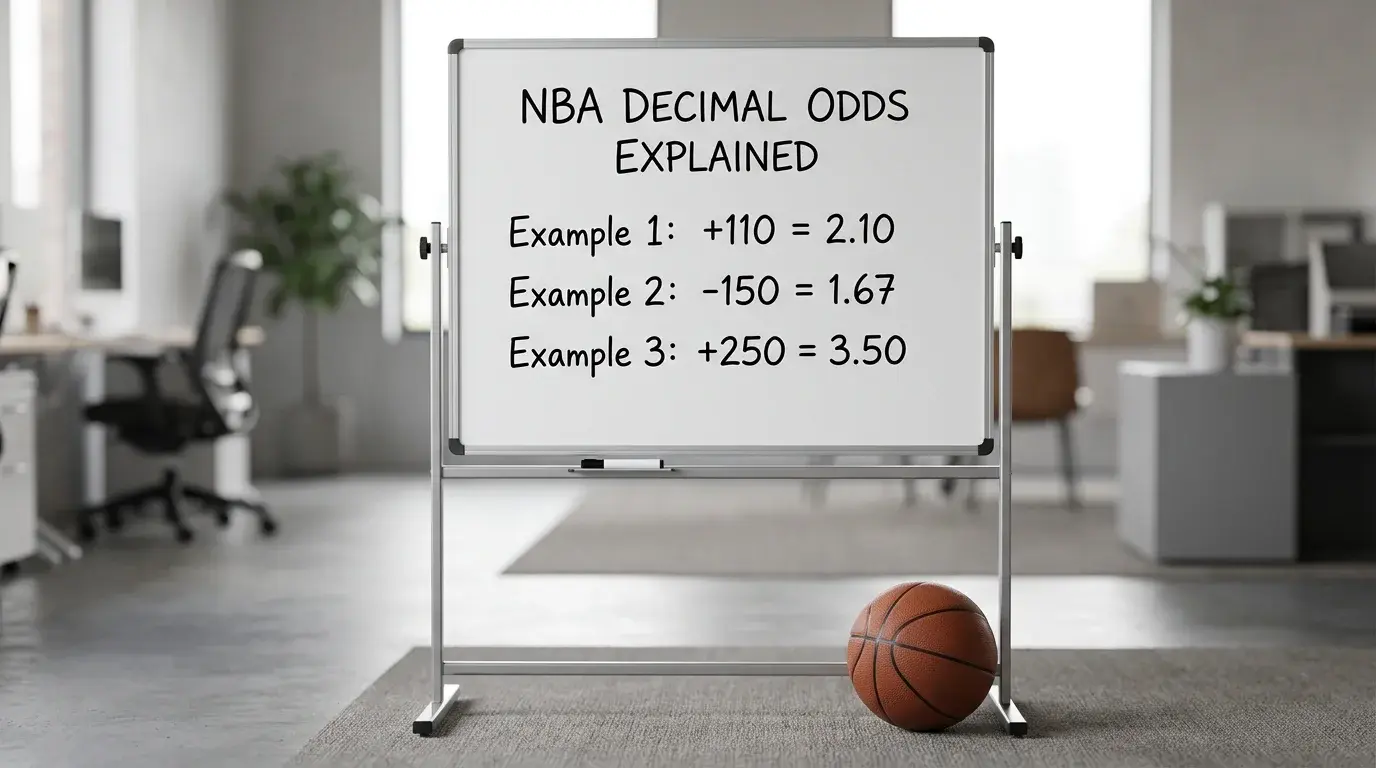
When I started betting on the NBA as a UK punter, the first obstacle was not the basketball itself — it was the odds. Every American resource quoted lines in moneyline format: +150, -110, -200. Every British punter I knew used fractional odds: 6/4, 10/11, 1/2. And then there were decimal odds — 2.50, 1.91, 1.50 — which my bookmaker defaulted to and which turned out to be the clearest format of the three. It took me longer than I would like to admit to understand why decimal odds are not just a preference but a practical advantage for anyone trying to compare value across markets.
UK punters place roughly 290 million online bets per month, and virtually all of those are priced in decimal or fractional format. For NBA betting specifically, decimal odds are the standard at UKGC-licensed bookmakers because they make payout calculations immediate and value comparison intuitive. This guide walks through the mechanics — no assumed knowledge, no skipped steps.
Calculating Payouts with NBA Decimal Odds
The beauty of decimal odds is their simplicity: the number you see is the total return on a one-unit stake, including your original stake. If you bet £10 at 2.50, your total return is £25 — that is £10 multiplied by 2.50. Your profit is £15. If you bet £10 at 1.50, your total return is £15 and your profit is £5. The calculation never changes: stake multiplied by odds equals total return.
In NBA markets, you will see decimal odds on every bet type. A spread bet on the favourite might be priced at 1.91, meaning a £10 stake returns £19.10. The underdog on the same spread is also 1.91 in a standard market. A moneyline favourite might be 1.35, while the moneyline underdog is 3.25. Totals — the over/under — typically sit in the 1.85 to 1.95 range for standard lines. Player props can vary widely, from 1.70 for a strong favourite on a points over to 4.00 or higher for an unlikely rebounds total.
The key advantage over fractional odds becomes apparent when comparing prices across bookmakers. Is 5/6 better or worse than 4/5? With fractional odds, the answer requires mental arithmetic. In decimal: is 1.83 better or worse than 1.80? Instantly clear. That clarity matters when you are checking four or five bookmakers in the minutes before tip-off, trying to lock in the best available price. Seconds count, and decimal odds save them.
One detail that trips up new punters: decimal odds of 2.00 represent an even-money bet. Anything above 2.00 means the potential profit exceeds the stake. Anything below 2.00 means the stake exceeds the potential profit. This is the baseline that separates “odds-against” from “odds-on” in decimal terms, and it is the reference point I use when quickly scanning a list of NBA markets for potential value.
Converting Between Decimal, Fractional and American Formats
I keep a conversion cheat sheet taped to the side of my monitor, not because I need it often but because occasionally an American source quotes a line in moneyline format and I need to translate it fast. The conversions are simple once you memorise the formulas.
Decimal to fractional: subtract 1, then express the result as a fraction. Decimal 2.50 becomes 2.50 – 1 = 1.50 = 3/2 in fractional. Decimal 1.91 becomes 0.91, which is approximately 10/11. Fractional to decimal: divide the fraction, then add 1. Fractional 5/2 becomes (5 / 2) + 1 = 3.50 in decimal.
Decimal to American: if the decimal is 2.00 or above, the formula is (decimal – 1) x 100. So 2.50 becomes +150. If the decimal is below 2.00, the formula is -100 / (decimal – 1). So 1.50 becomes -100 / 0.50 = -200. American to decimal reverses the process: for positive American odds, (American / 100) + 1, so +150 becomes 2.50. For negative American odds, (100 / absolute value of American) + 1, so -200 becomes 1.50.
About 75% of sports betting now occurs online, and every major platform lets you toggle between odds formats with a single click. But understanding the conversion means you can quickly assess value when reading American-focused analysis — which is where most NBA content originates. If an American analyst says “I love the Celtics at -110,” you immediately know that is 1.91 in decimal, which implies a 52.36% probability. That instant translation keeps you in the flow of analysis without reaching for a calculator.
Implied Probability and the Overround
Every decimal odds price carries an implied probability: the market’s estimate of how likely that outcome is. The formula is 1 / decimal odds x 100. Odds of 2.00 imply a 50% probability. Odds of 1.50 imply 66.67%. Odds of 3.00 imply 33.33%. This conversion is the single most important skill for identifying value, because it translates a price you see on screen into a probability you can evaluate against your own analysis.
Here is where the overround comes in. In a fair market, the implied probabilities of all outcomes would sum to exactly 100%. In practice, they never do. The bookmaker’s overround — also called the vig, juice, or margin — ensures the total exceeds 100%, with the excess representing the bookmaker’s built-in profit. On a standard NBA spread market, you might see 1.91 on each side. The implied probability of each side is 52.36%, which totals 104.72%. That 4.72% is the overround.
Adam Woodhead, a senior analyst at The Investors Centre, noted that two recent policy changes are shifting the tax landscape for UK investors — the annual capital gains exemption dropping by 76% and dividend tax rates rising. For punters, the parallel is the Remote Gaming Duty increase, which pushes bookmakers to protect their margins. Higher operator taxes translate into higher overrounds on the markets they offer, which means the can meaningfully affect the value you receive. An overround of 4.5% versus 6.0% on the same market is the difference between a manageable margin and a punishing one.
To calculate overround yourself: convert each outcome’s decimal odds to implied probability, sum them, and subtract 100. The lower the overround, the better the value for the punter. Different bookmakers apply different overrounds to different markets — spreads tend to carry the tightest overrounds, while player props and exotic markets carry wider ones. Comparing overrounds across bookmakers, not just comparing headline odds, gives you a structural advantage in finding the best prices consistently.