
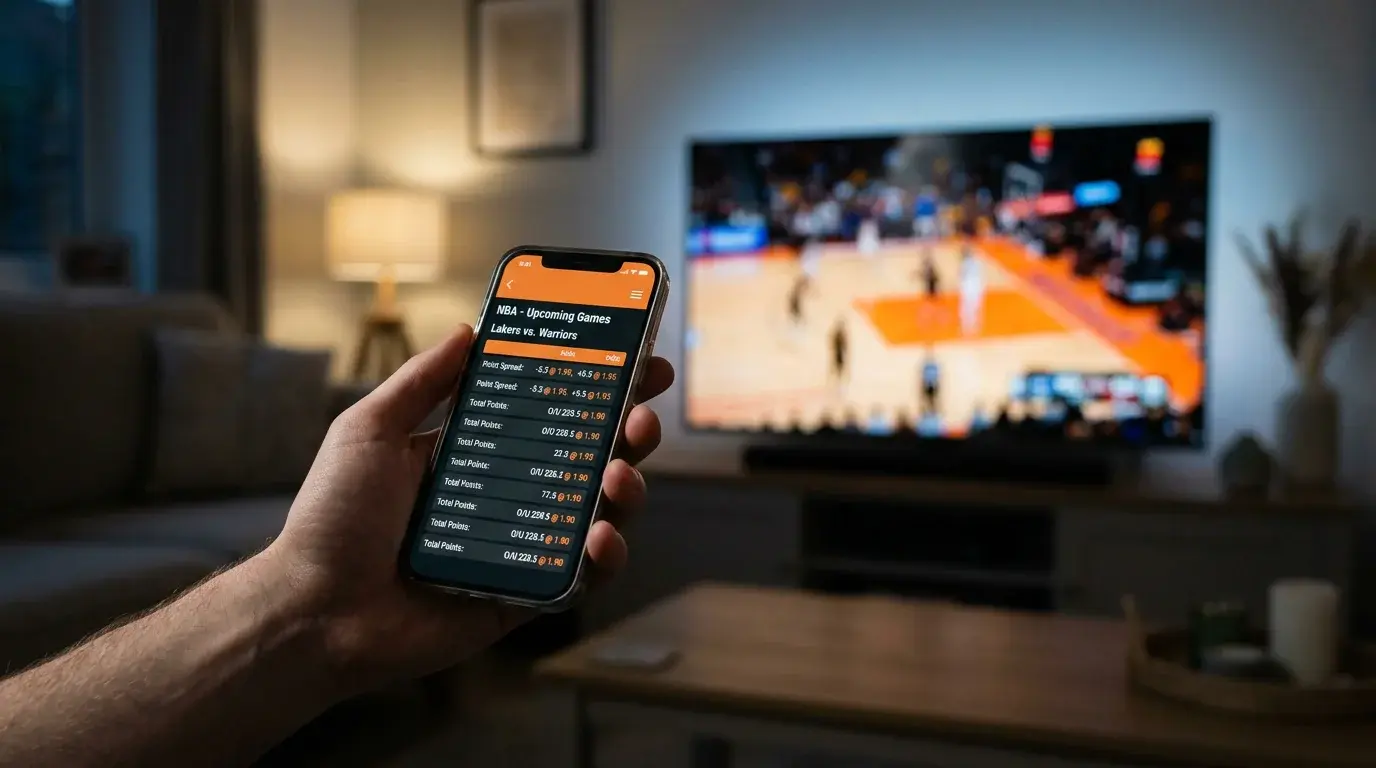
I spent the first three years of my NBA betting career using a single bookmaker. Not because I had evaluated the alternatives and decided this one was best — I simply opened an account with the first operator I found that offered NBA markets and never looked beyond it. When I finally started comparing odds across multiple platforms, I discovered I had been haemorrhaging value for years. On a typical NBA spread bet, the difference between 1.87 and 1.93 might seem negligible. Over two thousand bets, it is the difference between a losing record and a profitable one.
The UK sports betting market generates approximately £2.48 billion in annual gross gambling yield, making it one of the most competitive betting environments in the world. That competition benefits punters — more operators chasing market share means sharper odds, deeper markets, and better features. But competition also means noise. Dozens of UKGC-licensed bookmakers claim to offer comprehensive NBA coverage, and the reality behind those claims varies enormously. Some operators list NBA spreads and totals for every game but offer nothing beyond the basics. Others provide extensive player prop markets, quarter betting, live streaming, and bet-builder tools that transform NBA wagering from a simple punt into a layered analytical exercise.
This article is not a ranking. I am not going to tell you which bookmaker is “best” because the answer depends on how you bet, what markets you prioritise, and what features matter to your workflow. Instead, I am going to walk you through the criteria I use to evaluate NBA coverage at UK bookmakers, so you can make that decision with the same rigour you apply to the bets themselves.
Once you have chosen a reliable operator, your primary goal should be tracking your NBA closing line value to ensure long-term profitability.
UKGC Licensing Requirements for NBA Sportsbooks
A colleague of mine once asked why I only use UKGC-licensed operators when offshore books sometimes offer better NBA odds. The answer came six months later when that same colleague had a four-figure withdrawal frozen by an unlicensed Caribbean-based operator with no regulatory body to complain to. He never saw the money. That experience crystallised something I had understood abstractly but had not witnessed firsthand: licensing is not bureaucratic overhead. It is the structural foundation that makes everything else — odds quality, market depth, feature sets — actually matter, because none of those features help you if you cannot withdraw your winnings.
The UK Gambling Commission requires every operator serving British punters to hold a valid licence, and the conditions attached to that licence create a framework of protections that no unregulated market can replicate. Licensed operators must segregate customer funds from operational capital, meaning your deposited money and unwithdrawn winnings are ring-fenced in the event of insolvency. They must provide access to an independent dispute resolution service — the Alternative Dispute Resolution process — which gives you a formal mechanism to challenge decisions about voided bets, refused withdrawals, or account restrictions. These protections exist because the UKGC mandates them, not because operators volunteered them.
The financial landscape of UK betting shifted dramatically in April 2026 when the Remote Gaming Duty rose from 21 per cent to 40 per cent, with a new remote betting duty of 25 per cent following from April 2027. The UK government framed the increase as part of creating a fair, modern and sustainable tax system, projecting that the higher duties would generate more than one billion pounds annually. For NBA bettors, this tax increase has practical consequences. Operators absorb some of the additional cost through reduced margins on their most competitive markets, but the pressure inevitably flows through to less liquid markets — including niche NBA props and quarter lines — where wider margins compensate for the increased tax burden. Understanding this dynamic helps explain why the same bookmaker might offer razor-thin margins on an NBA spread but significantly wider margins on a first-quarter total.
Verifying a bookmaker’s licence is straightforward. Every UKGC-licensed operator must display their licence number on their website, and you can confirm its validity on the Gambling Commission’s public register. The licence number should appear in the footer of the site alongside the operator’s registered company name. If you cannot find a licence number, or if the number does not match the public register, that operator is not legally permitted to serve UK customers. I check licence status whenever I open a new account — it takes thirty seconds and eliminates the most significant risk in sports betting, which is not picking the wrong side of a spread but trusting your money to an entity with no obligation to return it.
Beyond the licence itself, look at the operator’s compliance history. The UKGC publishes enforcement actions — fines, licence reviews, and conditions imposed on operators who have fallen short of their obligations. An operator with a clean compliance record is not guaranteed to be perfect, but an operator with multiple regulatory actions against them is signalling systemic issues with how they treat customers. This information is public and free to access, yet most punters never check it.
Criteria for Evaluating NBA Market Coverage
When I sit down to assess a bookmaker’s NBA offering, I do not start with their welcome promotion or their app design. I start with a question that tells me more about their commitment to basketball than any marketing copy: how many markets do they list for a Tuesday night game between two mid-table teams in January? The marquee Christmas Day matchups and Finals games get full treatment from every operator. It is the unglamorous regular-season games that reveal whether a bookmaker takes NBA seriously or treats it as an afterthought behind football and horse racing.
Market breadth is the first criterion. A serious NBA operator should offer sides (moneyline and spread), totals (game and team totals), player props (points, rebounds, assists, three-pointers at a minimum), quarter and half markets, and futures (conference winners, MVP, season win totals). Some operators list fifty or more individual markets per game, while others offer barely a dozen. The difference matters because the less-covered markets — second-half spreads, alternate player prop lines, specific quarter totals — are often where the pricing inefficiencies live. If your bookmaker only offers the headline spread and total, you are competing against every sharp bettor in the market on the most efficient lines. If they offer deep prop and quarter markets, you have room to find edges where the bookmaker’s pricing model is thinner.
Odds competitiveness is the second criterion, and it requires ongoing monitoring rather than a one-time check. The largest operators in the UK market — some with group revenues exceeding fifteen billion dollars annually — have the volume to offer tighter margins, but they do not always choose to do so. I maintain a simple spreadsheet that tracks the opening spread and total odds across four bookmakers for every NBA game I consider betting. Over a month, clear patterns emerge: one operator consistently offers the best spread prices, another leads on totals, a third prices props most aggressively. This intelligence allows me to route each bet to the bookmaker offering the best price, which is the single most impactful habit a punter can develop.
Live betting depth is the third criterion. Not every operator treats in-play NBA markets with the same attention. Some suspend markets frequently during live play, leaving only intermittent windows to place bets. Others maintain running lines with relatively tight margins throughout the game. The quality of live pricing — how quickly it updates, how narrow the spreads are, and how often markets are available — varies widely, and for punters who bet in-play, it should be a primary selection factor rather than an afterthought.
Cash-out availability is the fourth criterion. The ability to close a position before a game ends — taking a partial profit on a bet that is winning or cutting a loss on one that is going against you — is a risk management tool that serious bettors use regularly. Not every bookmaker offers cash-out on NBA markets, and among those that do, the cash-out terms differ. Some apply aggressive margins to the cash-out price, effectively charging you a premium to exit your bet early. Others offer partial cash-out, where you can lock in profit on a portion of your stake while leaving the rest to run.
The remaining criteria — accumulator and bet-builder features, mobile experience, and withdrawal speed — are important but secondary. A bookmaker that excels at market breadth, odds competitiveness, live betting, and cash-out but has a slightly slower withdrawal process is still a better choice for serious NBA betting than one with instant withdrawals but thin markets and wide margins. Prioritise the factors that directly affect the expected value of every bet you place.
Odds Formats and Value Comparison
Early in my career I made the mistake of comparing NBA odds across bookmakers while one was set to fractional and the other to decimal. I thought I was getting a better price at the fractional bookmaker because the numbers “looked” different. It took an embarrassing conversation with a more experienced bettor to realise I was comparing apples to oranges and the prices were virtually identical. Since that day I have used decimal odds exclusively, and I would argue that any UK punter serious about NBA betting should do the same.
Fractional odds — the traditional UK format showing profit relative to stake, such as 10/11 — are intuitive for horse racing and football markets where the format has deep cultural roots. For NBA betting, where you are routinely comparing lines across multiple operators and calculating implied probabilities, decimal odds are superior for one simple reason: they make the maths transparent. A decimal price of 1.91 tells you immediately that your total return per pound staked is £1.91, and the implied probability is 1 divided by 1.91, which gives you 52.4 per cent. Try doing that mental calculation with 10/11 while scanning four bookmakers on your phone at midnight — it is slower and more error-prone.
American odds — the format used by US sportsbooks, showing -110 or +150 — are worth understanding because much of the NBA betting analysis and commentary available online originates from American sources. When you read a tweet about “getting +7.5 at -105,” you need to know that -105 in American format translates to 1.95 in decimal. The conversion is simple: for negative American odds, divide 100 by the number (ignoring the minus) and add 1. For positive American odds, divide the number by 100 and add 1. Roughly three-quarters of all sports betting activity takes place on online platforms, and the global default for those platforms is increasingly decimal. UK bookmakers all offer decimal display as an option, and most allow you to set it as the permanent default in your account settings.
The practical application of understanding odds formats goes beyond mere conversion. When I compare prices across bookmakers, decimal odds allow me to spot value differences instantly. If one bookmaker offers 1.91 on an NBA spread and another offers 1.95 on the same line, I know immediately that the second price represents a 2.1 per cent difference in implied probability. That gap is significant over hundreds of bets. In fractional format, the same comparison — 10/11 versus 19/20 — is less intuitive and slower to evaluate. Speed matters when lines are moving in the minutes after injury reports or sharp action.
I recommend setting every bookmaker account to decimal display on the day you open it. Consistency eliminates errors, and the format itself encourages the probabilistic thinking that separates profitable bettors from recreational ones.
NBA-Specific Features to Look For
Last season I discovered that one of my three regular bookmakers had quietly added NBA quarter spreads to their in-play offering. I had been placing these bets elsewhere at wider margins for months, not realising that a better option was sitting in an app I already had installed. The lesson: bookmaker feature sets change more frequently than most punters check, and a quarterly audit of what each operator offers for NBA is time well spent.
Bet builders — sometimes called same game parlays — are the feature that has most transformed NBA betting at UK bookmakers over the past three years. A bet builder lets you combine multiple selections from the same game into a single wager: a player to score over 25.5 points, the team to cover the spread, and the total to go over 215.5, all on one slip. The appeal is obvious — higher potential returns from a single game — but the pricing deserves scrutiny. Bookmakers apply correlation adjustments to bet-builder legs, and those adjustments are not always transparent. Two legs that are positively correlated in reality — such as a team covering a large spread and the total going over — should be priced to reflect that relationship, but the adjustment varies between operators. Comparing the combined bet-builder price across bookmakers for the same set of legs will sometimes reveal meaningful differences.
Quarter and half markets deserve more attention than they receive from most UK NBA bettors. First-quarter spreads, in particular, have a different dynamic to full-game spreads because they capture starting-lineup performance before coaching adjustments and bench rotations enter the picture. Some bookmakers offer quarter totals, quarter moneylines, and even quarter player props. If your NBA analysis identifies edges in specific game phases — say, you have a model for first-quarter scoring that outperforms your full-game model — then the depth of a bookmaker’s quarter markets should weigh heavily in your selection.
Live streaming availability is a feature that UK punters undervalue. Watching the game you have bet on is not just entertainment — it provides real-time information that enhances live betting decisions. Foul trouble, a player’s body language after a minor injury, a coaching decision to go small early — these observations feed live betting in ways that a box score cannot. Not all operators offer live streaming for NBA, and those that do may restrict it to certain games or require a funded account with recent betting activity. Live betting accounts for 62.35 per cent of online betting revenue globally, with annual growth exceeding 13 per cent, and the operators investing in streaming infrastructure are positioning themselves to capture that expanding market.
Early payout features — where a bookmaker settles your bet as a winner if your team leads by a specified margin at any point — are less common in NBA than in football, but some operators have introduced them for basketball. The trigger is typically a 20-point lead, which in the NBA is significant but far from insurmountable. The value of an early payout feature depends on how frequently your bets involve heavy favourites, since those are the teams most likely to build substantial leads. For punters who primarily bet spreads on closely matched games, this feature offers limited benefit.
Responsible Tools at UK Bookmakers
I set a deposit limit on my primary bookmaker account in 2019 after a bad week in the playoffs when I caught myself reaching for my phone to fund a top-up deposit at 1 AM. The limit I set was conservative — well below what I could afford — and it has saved me from impulsive decisions more times than I can count. Responsible gambling tools are not a sign of weakness or a concession that you have a problem. They are structural safeguards that protect your bankroll during the moments when discipline fails, and discipline always fails eventually.
Compare the latest promotional offers and market depth directly on the CourtEdge homepage.
Every UKGC-licensed bookmaker is required to offer deposit limits, loss limits, and session time reminders. These are not optional extras or premium features — they are regulatory mandates. Deposit limits allow you to cap the total amount you can fund into your account over a daily, weekly, or monthly period. Loss limits cap the total net losses within a defined period. Session time reminders alert you when you have been logged in for a set duration, which is particularly useful during late-night NBA sessions when fatigue erodes your awareness of how long you have been betting.
Self-exclusion through GAMSTOP provides a more comprehensive option. Registering with GAMSTOP blocks you from all UKGC-licensed online gambling sites for a minimum of six months, with options for one year or five years. The exclusion is not selective — you cannot choose which operators to exclude from — and it cannot be reversed during the chosen period. For punters who recognise that their relationship with NBA betting has shifted from analytical engagement to compulsive behaviour, GAMSTOP provides a hard barrier that willpower alone cannot replicate.
Among 18 to 24 year olds in the UK, 21.9 per cent score above zero on the Problem Gambling Severity Index — the highest rate of any age group and a figure that underscores why responsible tools matter. The NBA’s late-night scheduling in UK time zones, combined with the fast-paced excitement of live betting, creates an environment where sessions can extend well beyond what a punter originally intended. Reality checks — pop-up notifications that display your session duration and net position — are a practical countermeasure. I have mine set to trigger every sixty minutes, and the information it provides has changed my decision more than once.
When evaluating bookmakers, treat their responsible gambling implementation as a quality signal. Operators who make these tools easy to find, simple to configure, and impossible to circumvent are demonstrating a commitment to customer welfare that correlates with higher operational standards across the board. An operator that buries deposit limits three menus deep is telling you something about their priorities.