
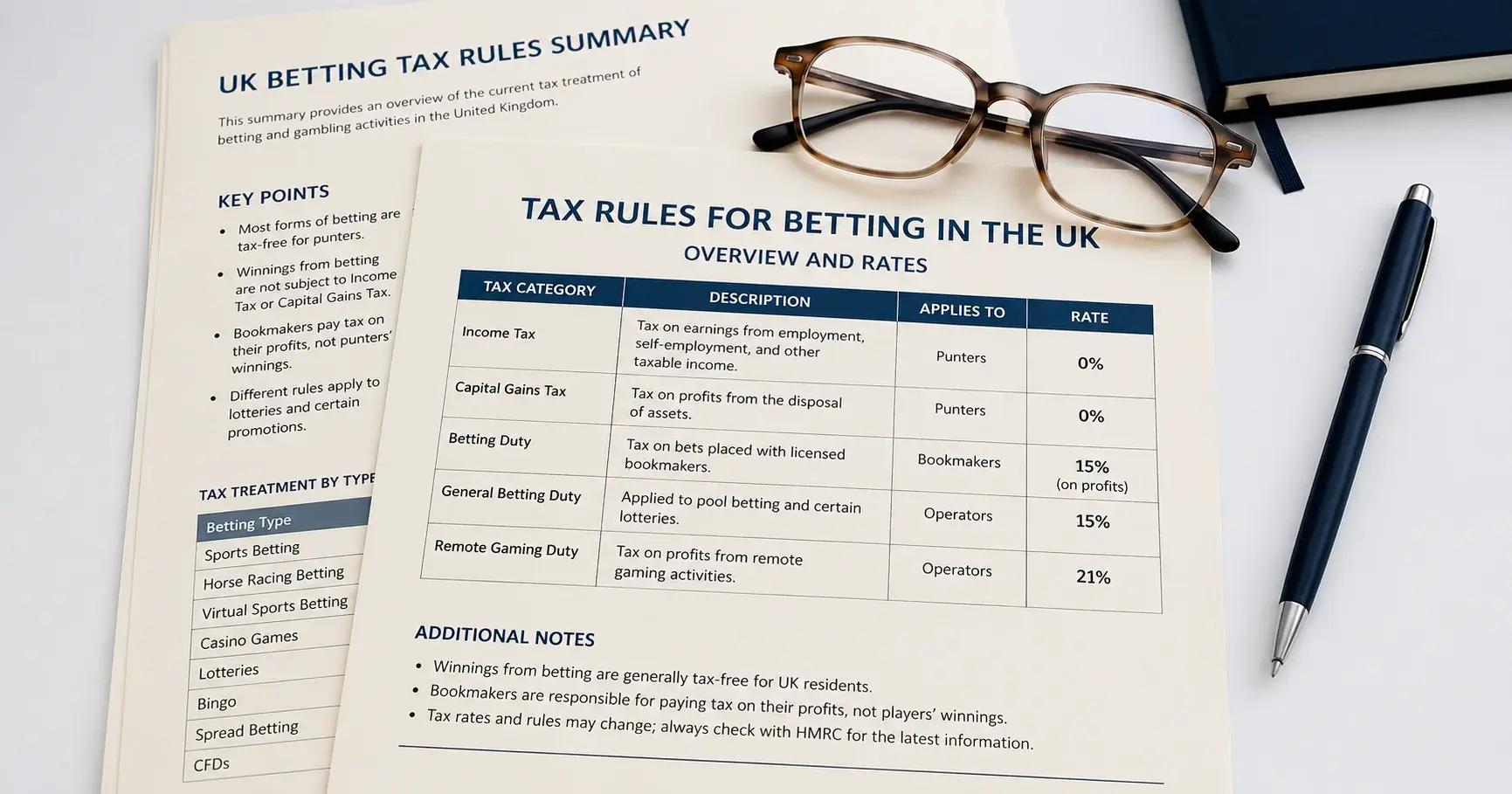
I get asked about tax more than any other non-basketball topic in my nine years of analysing NBA betting. The question usually comes from punters who have had a particularly good month and suddenly worry that HMRC is going to knock on their door. The short answer is: it will not. The longer answer involves a tax structure that is genuinely unusual by international standards, a major duty increase that took effect in April 2026, and a downstream impact on your NBA odds that most punters do not think about until it hits their payout.
The Remote Gaming Duty nearly doubled from 21% to 40% on 1 April 2026, making it one of the steepest gambling tax rates among major regulated markets. That increase does not appear on your betting slip, and HMRC will never send you a bill for it. But it shapes the odds you see, the margins your bookmaker builds into every NBA line, and ultimately the long-term return on every pound you wager. Understanding how the tax system works — even though you are not the one paying the tax — is a strategic advantage.
Tax Exemptions on UK Punter Winnings Explained
A friend of mine moved from the United States to London partly because of the tax treatment of gambling winnings. In the US, all gambling income above a certain threshold is taxable — winners fill out IRS forms, report their winnings, and pay federal and state income tax on the profit. In the UK, the system works differently: the tax obligation sits with the operator, not the punter. When you win a £500 NBA spread bet, that £500 is yours in full. No reporting, no deduction, no annual return.
This structure has been in place since 2001, when Gordon Brown’s government abolished the 9% betting duty that had previously been levied on punters’ stakes. The rationale was partly pragmatic — the old duty was driving bettors to offshore operators who did not charge it — and partly philosophical: the government decided that taxing the operators’ revenue was more efficient and harder to evade than taxing individual wagers. The result is a system where the government raises over £1 billion per year from gambling duties while punters pay nothing directly. Tax revenue from gambling is projected to hit £5 billion in the 2026-27 fiscal year, a 24.8% increase driven by the April 2026 duty hike.
The practical implication for NBA bettors is liberating: your bankroll calculations do not need a tax line item. If your model projects a 3% ROI over 500 bets, that 3% is your actual return — not a pre-tax return that shrinks after filing. This makes the UK one of the most favourable jurisdictions in the world for serious sports bettors, and it is a structural advantage that UK punters should not take for granted.
Remote Gaming Duty — What It Is and How It Affects Odds
Remote Gaming Duty is the tax that UKGC-licensed operators pay to HMRC on their gross gambling yield — the difference between the total amount staked by customers and the total amount paid out in winnings. Before April 2026, the rate was 21%. It is now 40%. That is not a marginal adjustment; it is a transformation of the operator’s cost structure, and it has direct consequences for the odds you are offered.
The UK’s sports betting market generates £2.48 billion in annual gross gambling yield, which means the industry’s aggregate tax bill under the new rate is approximately £992 million per year — nearly double the pre-April figure. Operators absorb some of that increase through cost-cutting and efficiency gains, but the rest flows through to the customer in the form of wider margins. In practical terms, this means the overround on NBA markets at UK bookmakers has increased since the duty hike. Where a pre-match NBA spread market might have carried a 4.5% overround in early 2026, the same market now carries closer to 5.5% or 6%.
For the average casual bettor placing a few pounds on tonight’s game, the difference is negligible — perhaps a few pence per bet. For serious punters wagering consistently across the NBA season, the cumulative impact is significant. A 1% increase in the overround means 1% less expected value on every wager. Over 500 bets at £50 per bet, that is £250 in additional margin cost across the season. The punters who will notice the difference most acutely are those operating on thin edges — the bettors who were already fighting to overcome the bookmaker’s margin and now face a wider gap between the decimal odds they see and the true probability of the outcome.
The April 2026 Duty Increase and Its Impact on NBA Markets
I compared the odds offered on identical NBA matchups before and after 1 April 2026, and the results confirmed what the maths predicted. On a sample of forty NBA games spanning late March to mid-April, the average overround increased by 0.8 percentage points. The shift was not uniform across all markets: pre-match spreads and totals showed the smallest increase (most operators absorb more of the duty on their highest-volume markets to remain competitive), while player props and alternative lines showed the largest increase (lower-volume markets where operators have more pricing flexibility).
The duty increase has also affected promotional activity. Free-bet offers, odds boosts, and sign-up bonuses are funded from the operator’s margin, and a wider tax obligation leaves less room for generosity. I have noticed fewer NBA-specific promotions since April compared to the same period last season. Enhanced-odds offers on marquee NBA games — which were common during the playoffs in previous years — have been scaled back at several operators. This is not speculation; it is a direct economic consequence of the duty increase.
Looking ahead, a further change is scheduled for April 2027, when the remote betting duty — a separate levy covering fixed-odds betting as distinct from gaming — rises to 25%. The combined effect of these two increases will further compress operator margins on NBA markets. The most likely response is continued margin widening on lower-volume NBA markets and a further reduction in promotional spending. For UK punters, the strategic response is clear: compare odds across multiple bookmakers before every bet, focus your volume on markets where the overround increase has been smallest, and treat promotional offers with scepticism rather than enthusiasm — the terms have tightened alongside the tax rate.