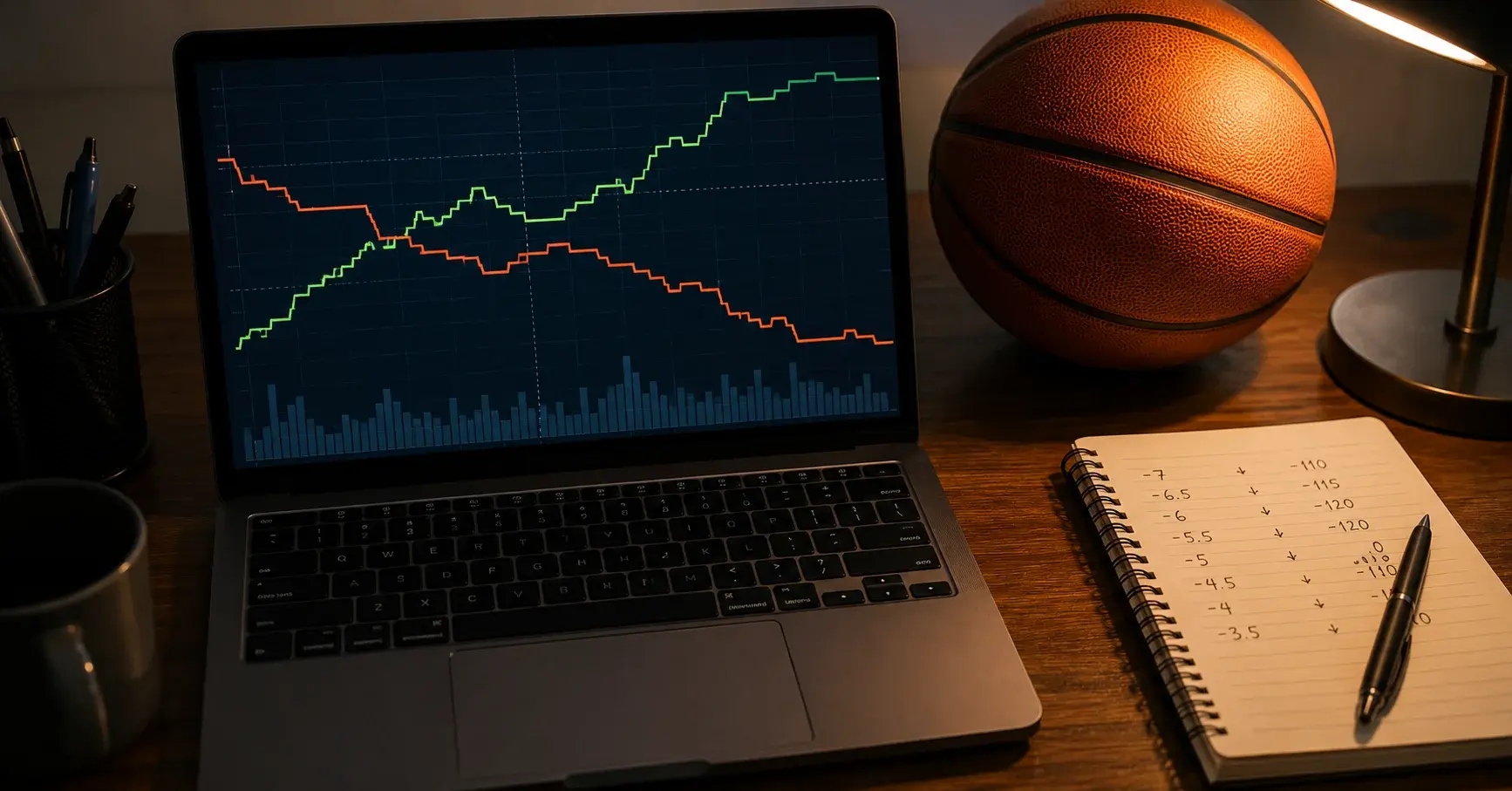

The moment I fell in love with NBA live betting was during a regular-season game between two playoff contenders. I had no pre-match position, but halfway through the second quarter, one team’s starting centre picked up his third foul and sat down. Within ninety seconds the live spread shifted by 2.5 points. I grabbed the adjusted line, the centre sat until the fourth quarter, and the bet cashed comfortably. That window — the gap between what happens on the court and when the market fully recalibrates — is where in-play betting creates genuine opportunity.
Live betting already accounts for 62.35% of online sportsbook revenue globally, and the NBA is one of the sports driving that growth. The fast-paced, high-scoring nature of basketball means the market reprices constantly: after every scoring run, every timeout, every substitution. For UK punters watching games that tip off between 23:00 and 03:30 BST, the challenge is not just reading the game — it is reading it quickly enough to act before the algorithm catches up.
This is not a guide for the casual viewer hoping to throw a bet on during halftime. This is a framework for making disciplined, data-supported decisions in a market that punishes hesitation and rewards preparation.
Understanding In-Play Recalculations of NBA Spreads
I used to assume live spreads simply tracked the scoreboard — if a team went up by ten, the spread moved by ten. That assumption cost me money until I understood the model underneath. Live NBA spreads are driven by algorithms that incorporate the pre-match line, current score differential, time remaining, team pace, foul trouble and even timeout availability. The algorithm does not react to the last basket; it projects the likely final margin based on all available data at that moment.
This means that a ten-point first-quarter lead does not produce the same spread shift as a ten-point fourth-quarter lead. Early leads are discounted because there is ample time for reversion. A team up by ten after the first quarter might see their live spread move by only four or five points from the pre-match line. The same ten-point lead with three minutes left in the fourth quarter could move the spread by eight or nine. Understanding this non-linear relationship is essential: it tells you when the market is overreacting to an early run and when it is appropriately adjusting to a late-game situation.
Timeouts are another underappreciated factor. When a trailing team calls a timeout during an opponent’s scoring run, the live spread often pauses or even tightens slightly because the algorithm projects that the timeout will break momentum. If you believe the timeout will fail to stop the run — perhaps because the trailing team’s defensive scheme has been exploited structurally, not just through a hot streak — the pre-timeout spread can offer value on the leading team.
Foul trouble creates the sharpest live-spread movements outside of actual scoring. When a star player picks up his fourth foul in the third quarter, the algorithm adjusts for projected minutes lost. That adjustment is immediate and often larger than the eventual on-court impact warrants, especially if the team has a competent backup. Identifying teams with strong bench depth allows you to exploit these overcorrections.
Spotting Momentum Shifts Before the Market Adjusts
There is a pub quiz question I like to pose to fellow punters: what matters more in basketball, the last five minutes or the next five minutes? The answer, for live betting purposes, is always the next five. Momentum is the most seductive and most dangerous concept in in-play wagering. A team hitting four consecutive threes feels unstoppable — until regression kicks in and they miss the next six.
Rather than chasing momentum, I look for structural shifts that the scoreboard has not yet reflected. A coaching adjustment — switching from a zone to man-to-man defence, or inserting a specific lineup to target a matchup — is a structural change that will affect scoring patterns for the remainder of the game. The live market does not always price in tactical adjustments immediately because the algorithm focuses on statistical inputs rather than schematic ones.
Substitution patterns are the easiest structural shift to identify in real time. If a team brings in its small-ball lineup against a traditional big man, the pace is likely to increase and the total to shift upward. If a team inserts a defensive specialist to shadow the opposing team’s primary scorer, individual prop lines and the total may both contract. Watching for these changes — rather than just following the score — gives you a genuine informational edge over the algorithm’s default projections.
I also track run differential by quarter. If a team consistently loses second quarters but dominates third quarters, the live market at halftime may not fully account for that pattern. Buying into a team’s live spread at halftime when their historical third-quarter performance suggests a likely surge is one of the more repeatable edges I have found in NBA in-play betting.
Quarter and Half Betting for UK Punters
Quarter markets deserve more attention than they get. Most NBA live bettors focus on the full-game spread and total, but quarter-specific markets — first-quarter spread, third-quarter total, fourth-quarter moneyline — offer distinct advantages for UK punters dealing with late-night tip-offs.
The practical reality is that an NBA game tipping off at 01:00 BST finishes around 03:30. Not every UK punter wants to stay up for the full four quarters. Quarter betting lets you engage with the portion of the game you are actually watching. A first-quarter bet resolves in about 35 minutes. A first-half bet resolves in roughly 70 minutes. You can go to bed having seen the outcome with your own eyes, rather than waking up to check a result.
From an analytical perspective, first-quarter markets are where I find the most consistent inefficiency. Opening-quarter performance is the most variable part of an NBA game — starters are still finding their rhythm, defensive intensity is uneven, and the pace has not yet settled. That variability means the bookmaker’s quarter line carries wider margins of error, which creates opportunity for punters who study how specific teams perform in the opening twelve minutes. Some teams are notoriously slow starters; others come out with maximum intensity and then fade. Around 80% of bets are placed via mobile, and the convenience of quarter markets on mobile apps — combined with push notifications that alert you to live opportunities — makes this an increasingly popular approach among UK punters watching NBA games late at night.
Chris Christie, the former New Jersey governor who was instrumental in overturning the federal sports betting ban, noted that “the regulated market is still working” — and the depth of in-play and quarter markets available at UKGC-licensed bookmakers is evidence of that. UK punters benefit from a mature regulatory framework that ensures the totals and quarter markets offered during live NBA games are fair, transparent and backed by the dispute-resolution mechanisms that UKGC licensing requires.